
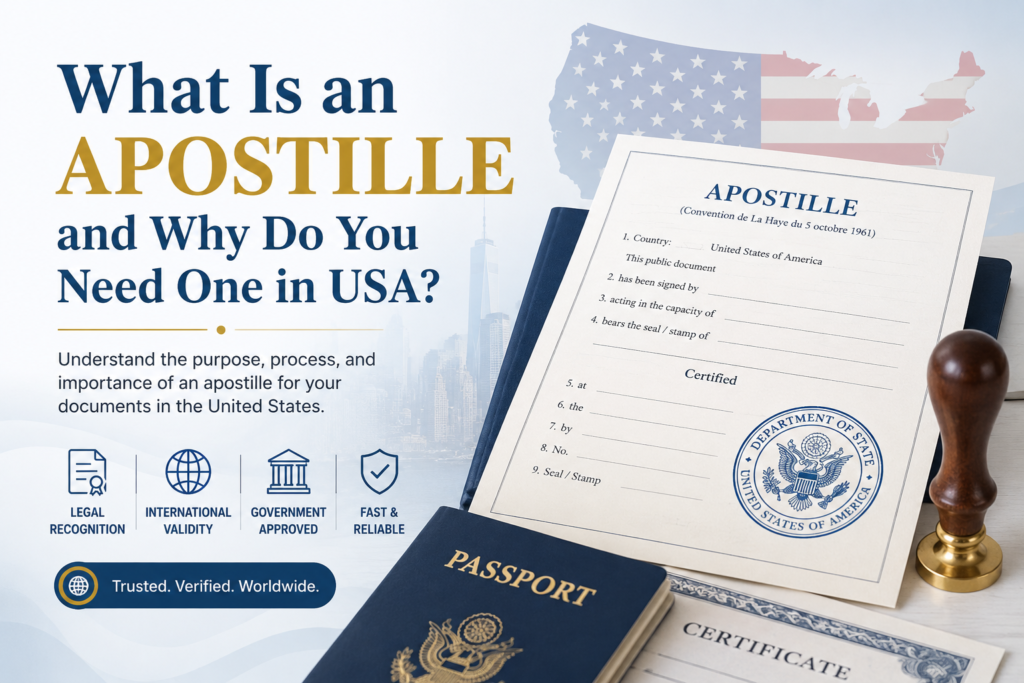
What is an Apostille and Why Do You Need One in the USA?
If you’ve ever tried to use an American document a birth certificate, diploma, marriage certificate, or power of attorney in another country, you’ve probably run into one unfamiliar word: apostille. It sounds complicated, but it’s actually a simple certification that can make or break whether your document is accepted abroad.
In this guide, we’ll break down exactly what an apostille is, why the United States requires it, and how to get one without the usual back-and-forth confusion.
What is an Apostille?
An apostille is a form of authentication issued for documents that will be used in a foreign country. It confirms that the signature, seal, or stamp on a public document is genuine, allowing the receiving country to trust it without further legalization.
The process comes from the 1961 Hague Convention, an international treaty that over 120 countries, including the United States, have signed. Instead of every country individually verifying every foreign document, an apostille acts as a universal stamp of authenticity recognized by all member countries.
Put simply: an apostille tells another country, “Yes, this document and the person who signed it are legitimate.”
Why Do You Need an Apostille in the USA?
If you’re a U.S. citizen — or someone using a U.S.-issued document abroad — you’ll typically need an apostille for situations like:
- Working or studying abroad: employers and universities often require apostilled diplomas, transcripts, or background checks
- Marriage or divorce abroad: many countries require an apostilled birth certificate or divorce decree before recognizing the union
- International business: apostilled powers of attorney, corporate documents, or contracts are often required to open a business or sign agreements overseas
- Adoption or immigration: many adoption and visa processes require apostilled civil documents
- Real estate transactions abroad: buying or selling property overseas frequently requires apostilled proof of identity or legal authority
Without an apostille, foreign governments, universities, and institutions may simply refuse the document no matter how official it looks.
How Does the U.S. Apostille Process Work?
Each U.S. state has its own Secretary of State office responsible for issuing apostilles for documents notarized or issued in that state. For example, documents from Texas are apostilled by the Texas Secretary of State, while documents from other states are apostilled by their respective offices.
The general process looks like this:
- Notarization: the document is signed in front of a licensed notary (if it isn’t already an official government-issued record)
- County or state-level certification: some documents need an extra layer of certification before apostille
- Apostille issuance: the relevant Secretary of State’s office reviews and attaches the apostille certificate
- Ready for international use: the document can now be submitted abroad without further authentication
This process can take anywhere from a few days to several weeks depending on the state and document type, which is where working with an experienced notary and apostille service saves significant time.
Apostille vs. Notarization: What's the Difference?
These two terms are often confused, but they serve different purposes:
- Notarization: confirms the identity of the signer and that they signed willingly; it’s a local, domestic-level verification.
- Apostille: verifies the notary’s or official’s authority itself, making the document valid for international use.
In most cases, a document needs to be notarized first, then apostilled, especially for personal documents like affidavits or powers of attorney.
How Luzail Notary & Apostille Can Help
Navigating apostille requirements, especially from abroad, can be time-consuming and confusing, particularly if you’re trying to apostille a Texas document while living outside the United States. Luzail Notary & Apostille specializes in helping clients:
- Notarize documents correctly the first time

- Prepare and submit documents for state-level apostille certification
- Avoid common rejection issues that delay processing
- Get clear timelines and guidance every step of the way
Whether you need a single document apostilled or a full set for immigration, education, or business purposes, our team handles the process so you don’t have to navigate it alone.
Need an apostille for a U.S. document? Contact Luzail Notary & Apostille today for a quick consultation and clear next steps.
Why Choose Professional Document Legalization Services?
Navigating international documentation requirements can be time-consuming and confusing. Professional experts can help you:
- Review your documents ✅
- Identify the correct legalization process ✅
- Coordinate translations when required ✅
- Reduce processing delays ✅
- Ensure compliance with local and international requirements ✅
This can save valuable time while minimizing the risk of rejected applications.
FAQs
No, only countries that are parties to the 1961 Hague Apostille Convention accept apostilles. Non-member countries require a different process called “legalization” or “authentication.”
An apostille itself doesn’t expire, but some receiving institutions may require the underlying document to be recently issued (often within 3–6 months).
Yes, though the process varies slightly by state. Documents must go through the Secretary of State of the state where they were issued or notarized.
Processing times vary depending on the issuing country, document type, and the authorities involved. Planning ahead is recommended.
Conclusion
Understanding the difference between an apostille and document legalization is essential when preparing documents for Qatar. Since Qatar generally requires legalization rather than apostille certification, following the correct authentication process helps ensure your documents are accepted without unnecessary delays.
Whether you’re moving to Qatar for work, education, business, or family reasons, working with experienced professionals can make the legalization process faster, smoother, and stress-free.