
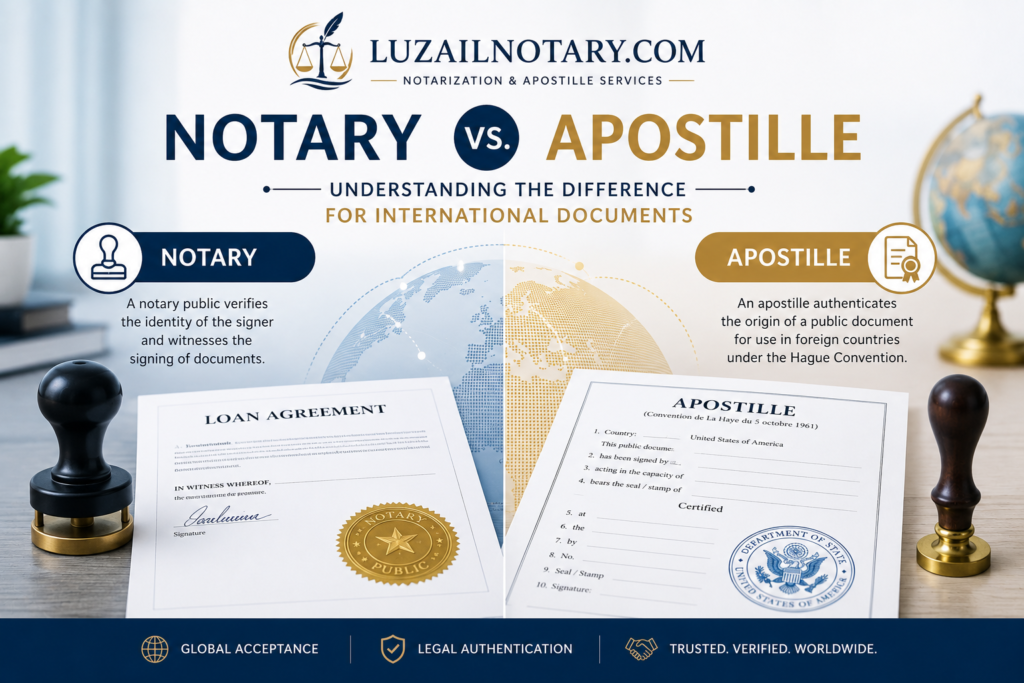
Notary vs Apostille
If you’ve ever prepared a document for use in another country, you’ve probably come across two terms that get used almost interchangeably: notary and apostille. While they’re closely related, they are not the same thing, and mixing them up is one of the most common reasons international document submissions get rejected or delayed.
Understanding exactly what each one does, when you need one versus the other (or both), can save you weeks of back-and-forth with foreign institutions, embassies, or government offices. This guide breaks down the difference clearly so you know exactly what your document needs before you submit it.
Table of Contents
What Is Notarization?
Notarization is a local, domestic-level verification process. A notary public, a state-commissioned official, witnesses the signing of a document and confirms:
- The identity of the person signing
- That the signer is doing so willingly and knowingly
- That the signature on the document is authentic
The notary then applies their official seal and signature to the document, creating a notarized record.
Notarization does not verify the content or truthfulness of the document itself; it simply confirms that the right person signed it, under proper conditions, in front of a licensed official.
Common documents that require notarization:
- Powers of attorney
- Affidavits
- Consent letters
- Loan and real estate documents
- Business contracts and agreements
Notarization is typically the first step in preparing a document — especially if that document will eventually need further certification for use abroad.
What Is an Apostille?
An apostille goes a step further than notarization. It’s an international-level certification that verifies the authenticity of the notary’s (or government official’s) signature and seal itself — not the document’s content, and not the original signer.
The apostille system comes from the 1961 Hague Apostille Convention, an international treaty currently recognized by more than 120 countries. Instead of requiring individual embassy legalization for every document, an apostille acts as a single, universally recognized certificate of authenticity among member countries.
In short: notarization verifies the signer. An apostille verifies the notary.
Common documents that require an apostille:
- Birth, marriage, and death certificates
- Educational diplomas and transcripts
- Corporate and business registration documents
- Adoption and custody paperwork
- Notarized powers of attorney intended for use abroad
Key Differences Between Notary and Apostille
Here’s a side-by-side breakdown to make the distinction clear:
- Purpose:
- Notarization confirms the identity and willingness of the signer
- An apostille confirms the authenticity of the notary’s or official’s signature/seal
- Scope of Recognition:
- Notarization is recognized only within the country (or state) where it was issued
- An apostille is recognized internationally, across all Hague Convention member countries
- Issuing Authority:
- Notarization is performed by a licensed notary public
- An apostille is issued by a government authority, typically the Secretary of State (in the U.S.) or an equivalent foreign affairs office
- When It’s Used:
- Notarization is used for domestic legal processes or as a preliminary step before international use
- An apostille is used specifically when a document needs to be legally accepted in another country
- Document Type:
- Notarization applies mainly to personal or business documents signed in front of a notary
- An apostille applies to a broader range, including government-issued vital records and educational documents
Do You Need Both Notary and Apostille?
In many cases, yes, the two processes work together rather than as alternatives.
- Personal documents like powers of attorney or affidavits typically need to be notarized first, then apostilled for international use.
- Government-issued records like birth certificates usually skip notarization and go straight to apostille, since they’re already considered official.
- Educational documents, such as diplomas, sometimes require an additional certification step (like verification from the issuing institution or state education department) before apostille.
The exact sequence depends on:
- The type of document
- The state or country where it was issued
- The requirements of the destination country
This is where many people get tripped up — assuming a notarized document is automatically ready for international use, when in fact it still needs an apostille to be recognized abroad.
What Happens If You Skip the Apostille?
A notarized-only document, when submitted to a foreign government, university, or institution, is often:
- Rejected outright
- Sent back with a request for additional certification
- Delayed for weeks while the correct apostille is obtained separately
This is especially common for expats and international businesses who assume domestic notarization is sufficient, only to discover the destination country requires apostille certification before the document holds any legal weight.
How to Get It Right the First Time
To avoid delays, it helps to:
- Confirm the destination country’s exact requirements before starting the process
- Determine whether your document needs notarization, apostille, or both
- Use a notary who is properly commissioned in the state where the document originates
- Work with a service experienced in both notarization and apostille submission, especially if you’re managing this from abroad
How Luzail Notary & Apostille Can Help
Navigating the difference between notarization and apostille and figuring out the correct order of operations can be confusing, particularly when you’re preparing documents from outside the United States. Luzail Notary & Apostille assists clients with:
- Determining exactly which certifications your document needs
- Coordinating proper notarization when required
- Managing apostille submission with the relevant Secretary of State
- Ensuring documents meet the specific requirements of your destination country
- Handling the entire process remotely, so you don’t need to be physically present in the U.S.
Whether you need a single notarized affidavit apostilled for a visa application, or a full set of business documents certified for international use, our team ensures the process is done the first time correctly — avoiding costly delays.
Not sure whether your document needs a notary, an apostille, or both? Contact Luzail Notary & Apostille today for a clear assessment and next steps.
Conclusion
The difference between a notary and an apostille comes down to scope: notarization verifies the person signing a document, while an apostille verifies the authority of the notary or official behind it, making the document valid internationally. Many documents require both, in a specific order, depending on the destination country’s requirements. Understanding this distinction upfront rather than after a rejected submission is the difference between a smooth international process and weeks of unnecessary delay.
FAQs
No. A notary can only notarize documents. Apostilles are issued exclusively by a designated government authority, such as a Secretary of State’s office.
No. Apostille applies only between Hague Convention member countries. If the destination country isn’t a member, the document requires embassy or consular legalization instead.
It depends on the document type and the destination country’s requirements. Personal documents like affidavits typically need both; government-issued records like birth certificates usually need only an apostille.