
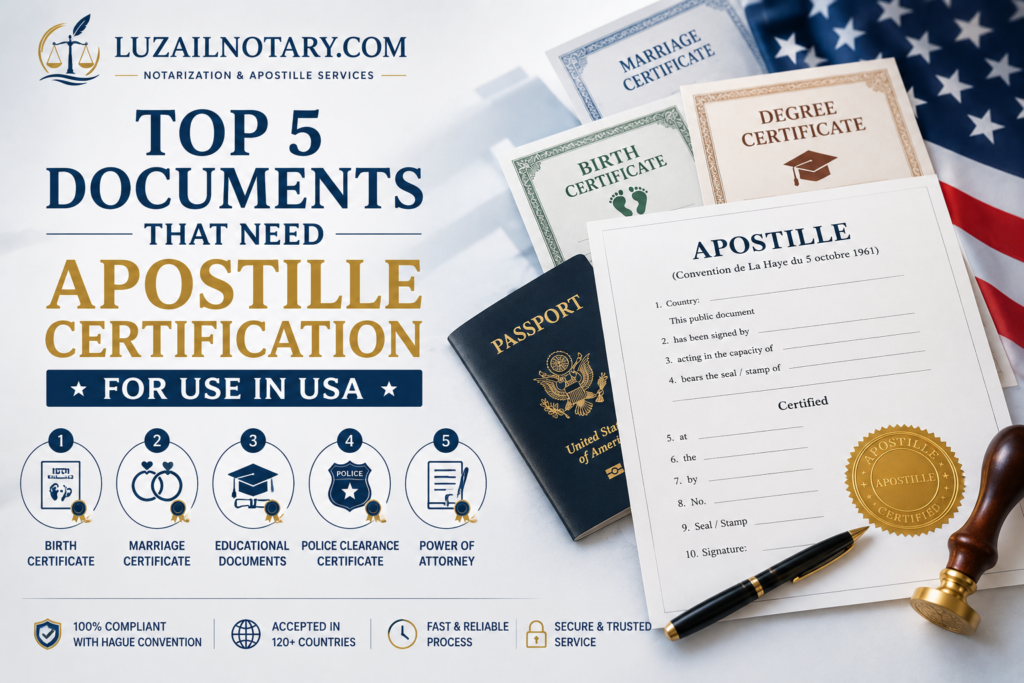
Documents That Need Apostille Certifications USA
If you’re preparing to move abroad, get married overseas, enroll in a foreign university, or expand your business internationally, you’ve probably heard that some U.S. documents require apostille certification before they’ll be accepted outside the country. But which documents actually need it?
This guide covers the top 5 documents that most commonly require apostille certification for use in the USA, why each one needs it, and how to avoid delays when getting them legalized.
Table of Contents
What is Apostille Certification?
Apostille certification is an official authentication process that verifies that a document’s signature, seal, or stamp is genuine, making it legally recognized in any of the 120+ countries that are part of the 1961 Hague Apostille Convention. Without this certification, U.S. documents are often rejected outright by foreign governments, universities, and institutions.
Now, let’s look at the five documents that need it most often.
1. Birth Certificates
A birth certificate apostille is one of the most frequently requested certifications, especially for:
- Registering marriages abroad
- Applying for dual citizenship or a foreign passport
- School or university enrollment overseas
- Immigration and residency applications
Only a certified copy issued by the relevant state’s vital records office qualifies — photocopies or hospital souvenir certificates will not be accepted for apostille.
2. Marriage and Divorce Certificates
Marriage and divorce certificates frequently require apostille certification for:
- Registering a marriage in a foreign country
- Applying for spousal visas or residency
- Remarriage abroad (requiring proof of a finalized divorce)
- Name change processes tied to international documentation
As with birth certificates, these must be certified copies from the issuing state or county — not personal copies kept at home.
3. Educational Diplomas and Transcripts
For anyone studying, working, or applying for licensure abroad, apostilled diplomas and transcripts are often mandatory. Common situations include:
- University applications requiring verified prior education
- Foreign employment requiring degree verification
- Professional licensing boards in other countries
- Credential evaluation services abroad
Some educational documents require an extra layer of certification from the state’s department of education before apostille — so it’s worth checking requirements early.
4. Powers of Attorney
A power of attorney (POA) used internationally — for property transactions, business decisions, or managing affairs on someone’s behalf — typically needs both notarization and apostille certification. This applies to:
- Real estate transactions abroad
- Managing a bank account or business from overseas
- Legal representation while living outside the country
- Healthcare or financial decision-making authorization
Since a POA is a personal legal document rather than a government-issued record, it must be notarized first, then submitted for apostille.
5. Corporate and Business Documents
Businesses expanding internationally often need to apostille documents such as:
- Articles of incorporation
- Certificates of good standing
- Board resolutions
- Commercial contracts and agreements
These documents are essential for opening foreign bank accounts, registering a branch office abroad, or entering into international business agreements. Because corporate documents often involve multiple signatories, it’s important to confirm every required signature is properly notarized before apostille submission.
How to Get These Documents Apostilled Correctly
Regardless of which document you’re certifying, a few best practices apply across the board:
- Always start with a certified copy or properly notarized original — never a photocopy
- Confirm your destination country is a member of the Hague Apostille Convention
- Check if any additional certification (county, state, or department-level) is required before apostille
- Allow extra processing time if submitting by mail rather than in person
- Work with a notary or apostille service if you’re managing the process from outside the U.S.
Common Mistakes to Avoid
- Submitting outdated or expired certified copies
- Using a notary not properly commissioned in the issuing state
- Skipping required pre-certification steps for educational or corporate documents
- Failing to specify the destination country on the apostille request
Each of these mistakes can result in your document being returned, adding weeks to an already time-sensitive process.
How Luzail Notary & Apostille Can Help
Whether you need a birth certificate, marriage certificate, power of attorney, or corporate document apostilled, Luzail Notary & Apostille handles the entire process so you don’t have to navigate U.S. state requirements on your own. Our team assists with:
- Reviewing your documents to confirm apostille eligibility
- Coordinating notarization when required
- Managing submission to the correct Secretary of State’s office
- Ensuring all pre-certification steps are completed correctly
- Arranging secure international delivery once certification is complete
This is especially valuable for clients living abroad who need documents apostilled without traveling back to the U.S. themselves.
Need one of these documents apostilled? Contact Luzail Notary & Apostille today for a clear, guided process from start to finish.
Conclusion
Apostille certification is required far more often than most people expect — from birth and marriage certificates to diplomas, powers of attorney, and corporate documents. Knowing which of your documents need this certification, and preparing them correctly from the start, can save significant time and prevent frustrating rejections abroad. Working with an experienced notary and apostille service ensures each document is certified properly the first time, no matter where in the world you’re submitting it from.
FAQs
Not always. Government-issued records like birth and marriage certificates typically go straight to apostille, while personal documents like powers of attorney need notarization first.
Yes. Each state has its own Secretary of State office responsible for apostille, and services like Luzail Notary & Apostille can manage submission on your behalf regardless of where you’re currently living.
Your document will require embassy or consular legalization instead of an apostille, which is a separate and often longer process.